Methodology & sources
This page documents the formulas, fixed values, and rounding rules behind every calculator on the site, and where those values come from. It backs the per-page “Assumptions & sources” block so any estimate can be checked by hand.
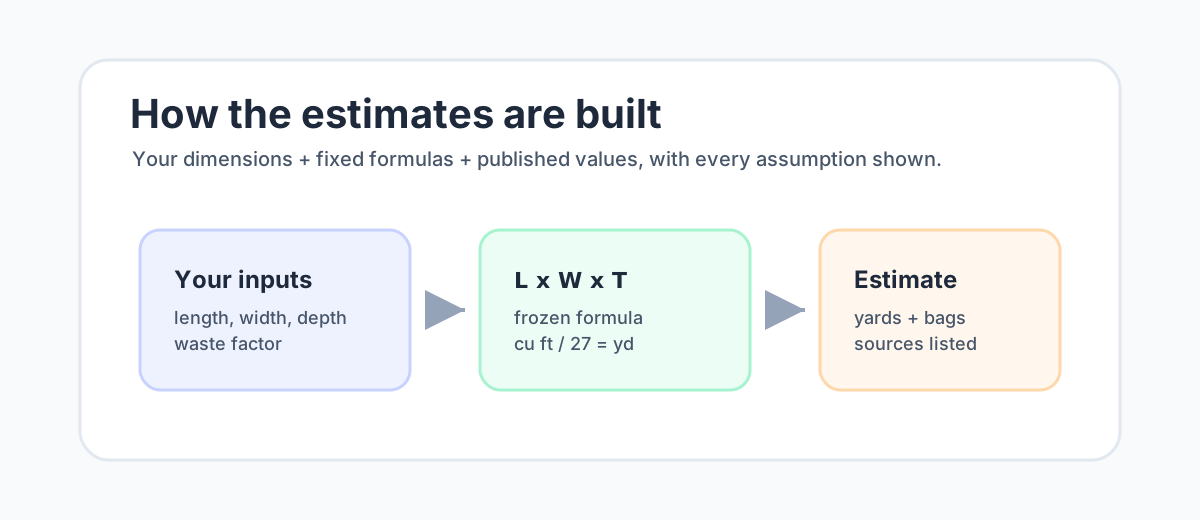
How the calculators work
What is the core volume formula?
Rectangular pours — slabs, pads, footings, and walls — use volume = length × width × thickness, with every dimension converted to feet first. Thickness entered in inches is divided by 12 to reach feet. The result in cubic feet is divided by 27 to get cubic yards, because a cubic yard is 3 ft × 3 ft × 3 ft = 27 cubic feet. Round holes use the cylinder formula, π × radius² × depth, where the radius is half the entered diameter. These are standard geometric formulas, not site-specific constants, so they do not change between pages.
How is the waste factor applied?
After the base volume is computed it is multiplied by (1 + waste percentage). The default is 10%, which covers ordinary job-site losses: spillage, uneven subgrade, over-excavation, and material left in the mixer, chute, or bag. The waste factor is a planning allowance, not padding — raise it for rough hand excavation or collapsing post holes, and lower it only for tightly formed work on a level, compacted base. See the waste factor guide for when to use 5%, 10%, 15%, or 20%.
How are bag and block counts rounded?
Bag, block, and mortar counts are always rounded up to a whole unit, because you cannot buy a fraction of a bag. Rounding uses a small epsilon tolerance so a value like 12.0000001 — a floating-point artifact — is treated as 12 rather than forced up to 13. Cubic yards and cubic feet are shown to two decimals and are not rounded up, so you can compare them against a supplier's quarter-yard ordering increments yourself.
Fixed values and where they come from
What bag yields are assumed?
Bag yields are approximate dry-mix volumes per bag, based on the yields published by major bagged-concrete manufacturers such as QUIKRETE and Sakrete — an 80 lb bag of standard concrete mix is commonly listed at about 0.60 cubic feet. They are planning numbers — always confirm the exact yield printed on the product you buy.
| Bag size | Assumed yield | Bags per cubic yard |
|---|---|---|
| 40 lb | ≈ 0.30 cu ft | ≈ 90 |
| 50 lb | ≈ 0.375 cu ft | ≈ 72 |
| 60 lb | ≈ 0.45 cu ft | ≈ 60 |
| 80 lb | ≈ 0.60 cu ft | ≈ 45 |
The concrete bag sizes guide explains these yields and pallet weights in more detail.
What block and mortar coverage is assumed?
Concrete block (CMU) counts assume a nominal 16 in × 8 in face including a standard 3/8 in mortar joint, giving about 1.125 blocks per square foot of wall before waste. Mortar is estimated from typical bag coverage for that joint, and 8 in and 12 in core-fill volumes use the published hollow-core volume per block. These follow the standard CMU dimensions in ASTM C90 and National Concrete Masonry Association (NCMA) references; verify against the specific block and mortar you buy.
Where do frost-line and footing cautions come from?
Footing and post-hole pages point to the 2024 International Residential Code (IRC R403.1.4 / R403.1.4.1), which requires exterior footings to extend below the local frost line where frost protection applies. The calculator does not know your jurisdiction's adopted frost depth, so it gives planning reference depths only — your local building department sets the value that governs the pour.
What these estimates are — and are not
Are the results a quote?
No. Every result is a material estimate, not a price quote or an engineered design. Concrete cost varies by mix, brand, supplier, region, delivery minimum, short-load fee, site access, and finishing. Cost pages clearly label what is included (material only versus an installed estimate) and keep that boundary explicit. For structural slabs, footings, retaining walls, and frost-depth work, confirm with a qualified professional or your local building authority.
How are these values kept current?
Each page carries a “last updated” date that is bumped whenever a formula, fixed value, or piece of content changes, and the same date drives the structured-data freshness signal. If you find a value that no longer matches current products or code, use the contact page to report it. We do not publish fabricated reviewer credentials or first-person testing claims; the trustworthiness of the site rests on checkable formulas and openly stated sources.
Which calculator should I start with?
Start from the calculators hub to pick the tool that matches your job, or read how to calculate concrete to follow the volume math by hand before you trust any tool with your numbers.